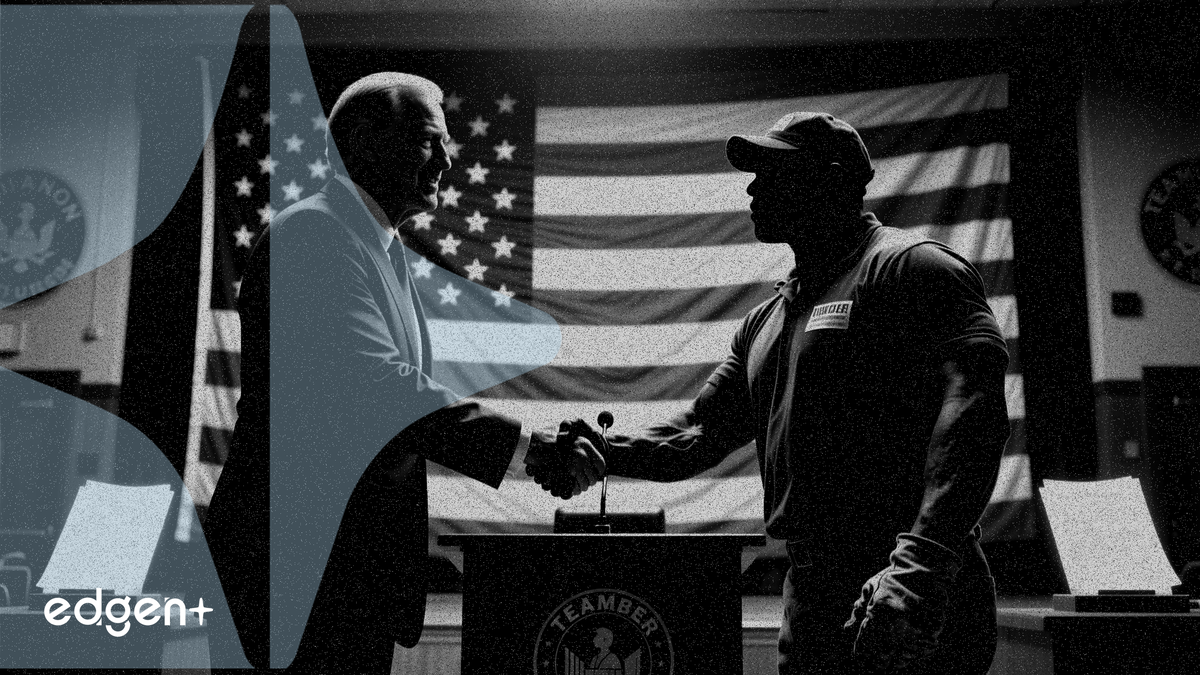
Vice President JD Vance is pressing the White House and House Republicans to pass two Teamster-backed labor bills, handing the union a chance at legislative wins even as 92% of its political donations flow to Democratic candidates.
"The Teamsters have been very clear about what they need, and I think there's a lot of common ground between their agenda and what this administration wants to do for working people," Vance told House Republicans during a recent push for the Railway Safety Act, according to people familiar with the calls. He also pressed President Donald Trump to endorse the measure last month.
The Railway Safety Act, co-sponsored by Vance when he was a senator after the February 2023 Norfolk Southern derailment in East Palestine, Ohio, would impose new labor mandates on railroads including minimum crew sizes and enhanced inspection requirements. Farmers and fossil-fuel producers have argued the bill would raise transportation costs without improving safety, and it lacked sufficient Republican support to pass either chamber in the last Congress. The Teamsters have pushed to attach it to this year's highway-funding reauthorization.
A second bill, the Faster Labor Contracts Act, would allow an arbitration panel to impose a contract if a union and employer fail to reach an agreement after 120 days of bargaining. Modeled on a California farm labor law, the measure would give unions more leverage while removing the requirement for workers to ratify the final contract. Seven House Republicans have signed a discharge petition to force a floor vote.
The legislative push comes as Teamsters President Sean O'Brien, elected in 2021, faces a re-election campaign and needs to show his 1.3 million members tangible results from his strategy of courting Republicans. The union's membership has shrunk by nearly half since the 1970s amid a broader decline in organized labor and the migration of jobs to right-to-work states. Between 2016 and 2025, members filed 373 petitions to decertify the Teamsters, with 60% of those elections succeeding, according to Reason magazine.
O'Brien's hard-line bargaining approach has produced mixed results. In 2023, he refused financial concessions from Yellow Corp., one of the country's largest trucking companies, tweeting an image of a gravestone reading "Yellow 1924-2023." The company filed for bankruptcy, and 22,000 Teamsters lost their jobs. A deal with UPS that same year increased average compensation for full-time drivers to $170,000 from $145,000 over five years, including zero healthcare premiums and as much as seven weeks of vacation. Rising labor costs prompted UPS to cut 34,000 nonmanagement jobs last year, with another 30,000 planned for this year.
The political calculus for Republicans carries risk. In the 2023-24 election cycle, 92% of Teamsters PAC donations to federal candidates went to Democrats, as did 91% of the union's contributions to party committees. An independent investigations officer, mandated by a court because of the union's longstanding corruption problems, issued a report in February accusing two former Teamster officials of treating the union credit card "as a blank check to permit them luxury living without limit," including restaurant tabs for meals with friends topping $3,000.
O'Brien declined to endorse Trump in 2024 even though internal polls showed Teamster members favored the Republican over Kamala Harris. He has similarly avoided committing to any Republican presidential contender for 2028, preserving his political leverage.
Other potential Republican presidential candidates have also courted the union. Then-Sen. Marco Rubio of Florida backed a Teamster affiliate during a 2022 railroad contract dispute. Missouri Sen. Josh Hawley is championing the Faster Labor Contracts Act.
The last major federal intervention in railroad labor came in December 2022, when Congress imposed a contract agreement to avert a strike that would have shut down 30% of U.S. freight shipments, costing an estimated $2 billion per day. That intervention blocked a strike but also denied workers the sick leave they had demanded — a dynamic the Teamsters are now seeking to reverse through legislation.
This article is for informational purposes only and does not constitute investment advice.