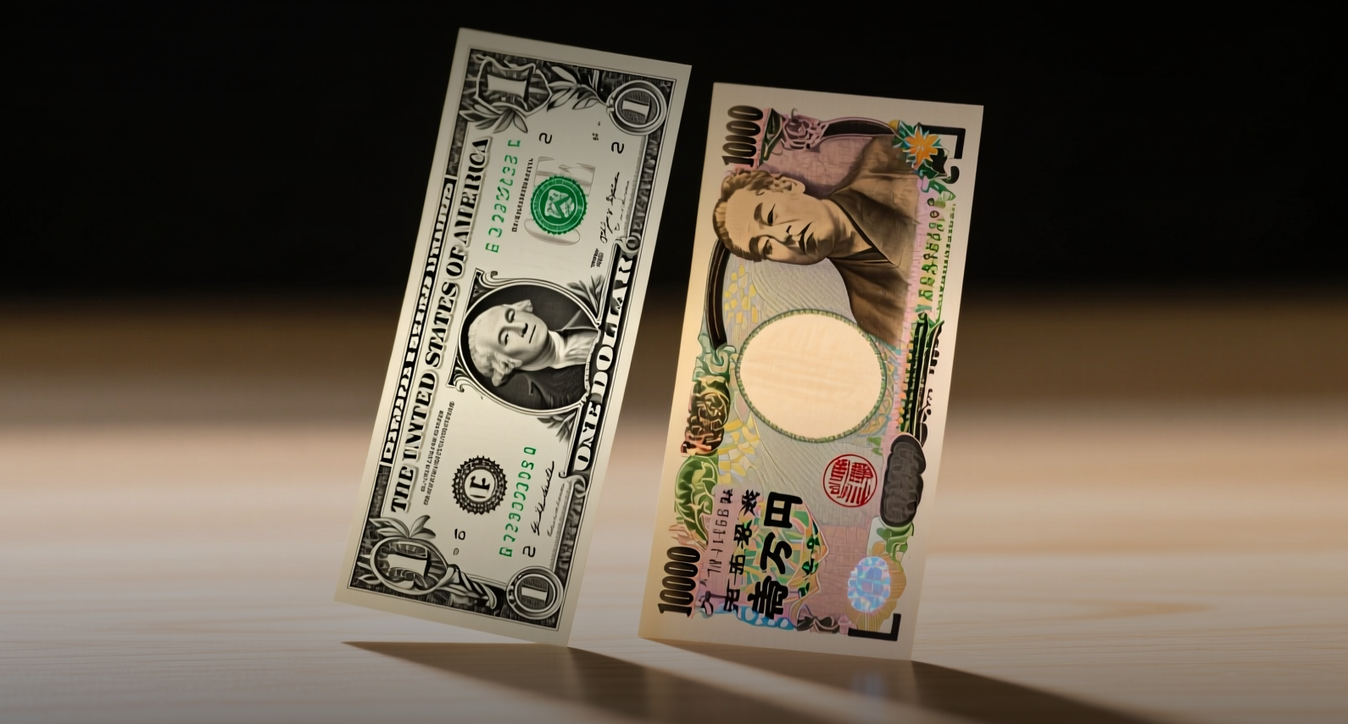
The dollar-yen pair is within striking distance of a key resistance level, with Thursday's US payrolls report set to determine whether the next leg higher has the momentum to hold.
USD/JPY enters the final week of June within striking distance of the 161.95 resistance level, as Thursday's US nonfarm payrolls report becomes the defining catalyst for whether the pair can sustain a breakout or reverses sharply.
"The market is pricing a binary outcome — a strong payrolls print above 150,000 would reinforce the hawkish repricing that followed the May report and likely push USD/JPY through 162," said Shusuke Yamada, chief Japan FX strategist at Bank of America Securities in Tokyo. "A miss below 100,000, however, could trigger a rapid unwind of dollar longs."
Consensus expectations point to a gain of around 115,000 jobs in June, down from May's 172,000 but still above the breakeven pace the Atlanta Fed estimates at roughly 100,000. The unemployment rate is forecast to hold at 4.3 percent, while average hourly earnings are expected to ease to 3.3 percent year-over-year from 3.4 percent. The May report single-handedly reset the rate conversation — market-implied odds of a Federal Reserve rate hike by October surged to 100 percent, with a 30 percent probability of a move as soon as July.
A strong payrolls number would validate the hawkish tone struck by Fed Chair Kevin Warsh at the June 16-17 FOMC meeting, where the median core PCE inflation projection for 2026 was raised to 3.3 percent and the adjusted expected funds rate landed at 3.8 percent. That would push USD/JPY through 161.95, a level that has capped the pair since April, and open the path toward the 2026 high near 164. A weak print, by contrast, would challenge the entire rate-hike narrative and could send the pair back toward the 50-day moving average near 157.50.
The divergence between US and Japanese monetary policy remains the structural driver. The Bank of Japan has offered little new guidance in recent weeks, leaving the yen entirely at the mercy of dollar dynamics. Japan's Ministry of Finance has not intervened since the April-May period when USD/JPY traded above 160, and officials have signaled they are monitoring the pace of moves rather than specific levels.
The cross-asset backdrop adds to the stakes. US equities have shown increasing divergence — the small-cap Russell 2000 is outperforming the Nasdaq 100 by roughly 4 percentage points year-to-date as AI spending concerns weigh on the Magnificent Seven. A strong payrolls report that reinforces the rate-hike narrative could accelerate that rotation, with higher discount rates pressuring the long-duration tech names that dominate the Nasdaq. That would likely strengthen the dollar further as capital rotates out of growth equities into short-duration Treasuries, with the 10-year yield already testing the 4.80 percent level after May's data.
Rate Differentials Widen to a Two-Year Extreme
The US-Japan 10-year yield spread has widened to approximately 340 basis points, near the widest level since late 2024. That differential is the primary fuel for the carry trade that has kept the yen under sustained pressure. Goldman Sachs and J.P. Morgan both pushed back their Fed rate cut timelines last week — Goldman now expects the first cut in June 2027, while J.P. Morgan projects a potential 25-basis-point hike in September 2027. The Bank of Japan, meanwhile, faces its own constraints: core inflation remains above target at 2.5 percent, but the economy's fragile recovery limits the scope for aggressive tightening.
The last time USD/JPY traded above 162 was in April 2026, when the pair touched 164.20 before the Ministry of Finance intervened with an estimated ¥3.5 trillion in dollar-selling operations. That intervention produced a sharp but temporary reversal — the pair recovered within two weeks. The lesson for traders is that while intervention can slow the move, it cannot reverse the fundamental rate differential without a shift in either the Fed's or the BoJ's policy trajectory.
Thursday's payrolls report will also carry implications beyond the yen. A hot print would reinforce the higher-for-longer rate environment that Goldman Sachs and J.P. Morgan have embedded in their forecasts, with implications for gold, which has already fallen 4.68 percent in a single week after May's data, and for emerging-market currencies that are sensitive to dollar strength. A soft print would ease those pressures but would need to be convincingly below 100,000 to challenge the prevailing hawkish consensus.
This article is for informational purposes only and does not constitute investment advice.