
Tesla has begun testing a production Cybercab on public roads in Austin — a two-seat vehicle with no steering wheel or pedals, relying entirely on a Level 4 autonomous system.
Tesla has begun testing a production Cybercab on public roads in Austin — a two-seat vehicle with no steering wheel or pedals, relying entirely on a Level 4 autonomous system.
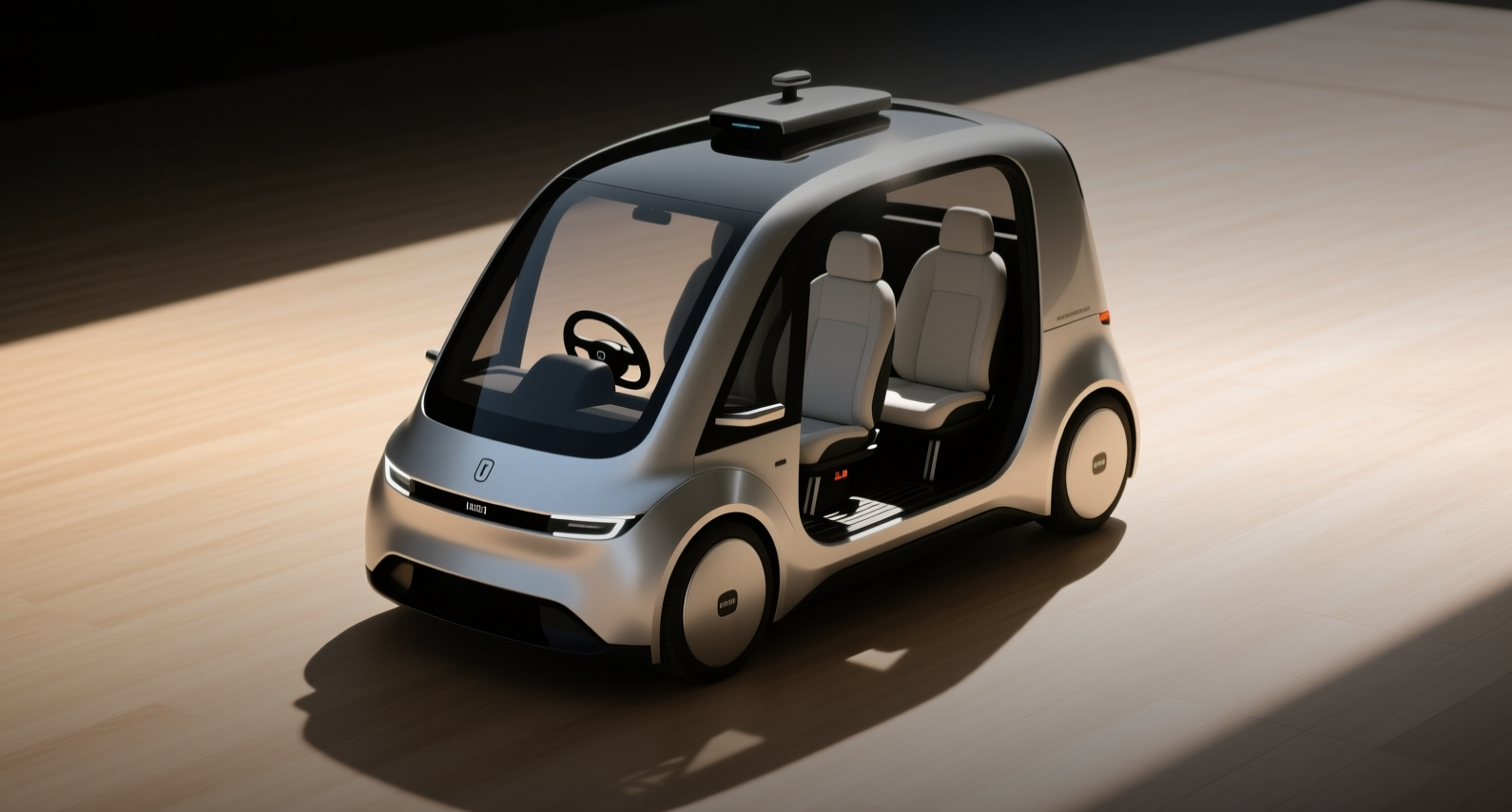
Tesla's Cybercab, a fully autonomous two-seater with no manual controls, began engineering tests on Austin streets, advancing the company's robotaxi ambitions beyond the Model Y-based fleet already operating in the city.
"Engineering tests of the first production Cybercab have begun in Austin," Tesla said on X, with Chief Executive Elon Musk resharing the post and noting the vehicle was driving with "no steering wheel or pedals."
The Cybercab uses Tesla's SAE Level 4 automated driving system, which can perform the entire driving task without human input, according to a first-responder guide published by the Texas Department of Public Safety. Unlike Tesla's current robotaxis — modified Model Y vehicles that retain a steering wheel and pedals for human intervention — the Cybercab is built without driver controls from the factory. The interior features only two seats and a large display showing the estimated time of arrival. Tesla first unveiled the Cybercab at its "We, Robot" event in Burbank, California, in October 2024, promising a commercial rollout by June 2025 — a deadline the company missed.
TSLA shares jumped 8.1% on Monday to $411.84, their best single-day gain in more than a year, buoyed by the Cybercab news and the rollout of FSD V14 Lite to older Hardware 3 vehicles. The Cybercab program represents a potential new revenue stream for Tesla, though the company missed its initial June 2025 target for commercial deployment.
Tesla's entry into purpose-built autonomous vehicles pits it directly against Waymo, the Alphabet unit that has operated a commercial robotaxi service in Phoenix, San Francisco and Los Angeles since 2020. Waymo's fleet uses modified Jaguar I-Pace and Zeekr vehicles with steering wheels, though the company has said its sixth-generation system can operate without them. Cruise, the General Motors subsidiary, resumed testing in select cities last year after a pedestrian-dragging incident in 2023 halted operations nationwide. Uber and Lyft have also pursued autonomous partnerships, with Uber integrating Waymo vehicles into its platform in several markets.
The regulatory environment in Texas gives Tesla an advantage. The state has few restrictions on autonomous vehicle testing, a factor that contributed to Musk's decision to move Tesla's headquarters from California to Austin in 2021. California's more stringent rules — including a requirement that autonomous vehicles have a licensed operator on board — have slowed deployments there. Texas added the Cybercab to its first-responder interaction plans this month, providing emergency personnel with guidance on how to handle the driverless vehicle in accidents or traffic stops.
The Cybercab's Level 4 designation means it can handle all driving tasks within a defined operational design domain — in this case, Austin's city streets. Tesla has not disclosed the sensor suite for the Cybercab, but the vehicle is expected to rely on the company's camera-based vision system rather than lidar, which Waymo and Cruise use. That approach has drawn skepticism from some safety experts, who argue that cameras alone struggle in low-visibility conditions such as heavy rain or glare. Tesla has not published independent test data comparing its vision-only system to lidar-equipped competitors.
A video posted by Musk shows a safety monitor seated in the right passenger seat during the test, with no ability to take control of the vehicle. Tesla has acknowledged that employees may remotely control Cybercabs in certain situations, according to a report from Wired. The company did not specify how many Cybercabs are currently in the test fleet or when it plans to expand testing beyond Austin.
For investors, the Cybercab tests show that Tesla is making tangible progress toward a fully autonomous vehicle — a goal Musk has described as the company's primary value driver. Tesla trades at roughly 95x trailing earnings, a premium that reflects expectations for the robotaxi business rather than its automotive margins, which have compressed as price cuts and slowing EV demand weigh on results. The company delivered 387,000 vehicles in the first quarter, down 13% from a year earlier.
Waymo, by contrast, operates as part of Alphabet, which trades at 22x forward earnings. The unit does not disclose standalone financials, but analysts at UBS estimated in March that Waymo could generate $8 billion in revenue by 2030. Tesla has not provided revenue projections for its robotaxi network, leaving investors to estimate the potential value of a fleet that could eventually number in the millions of vehicles, according to Musk's public statements.
This article is for informational purposes only and does not constitute investment advice.
