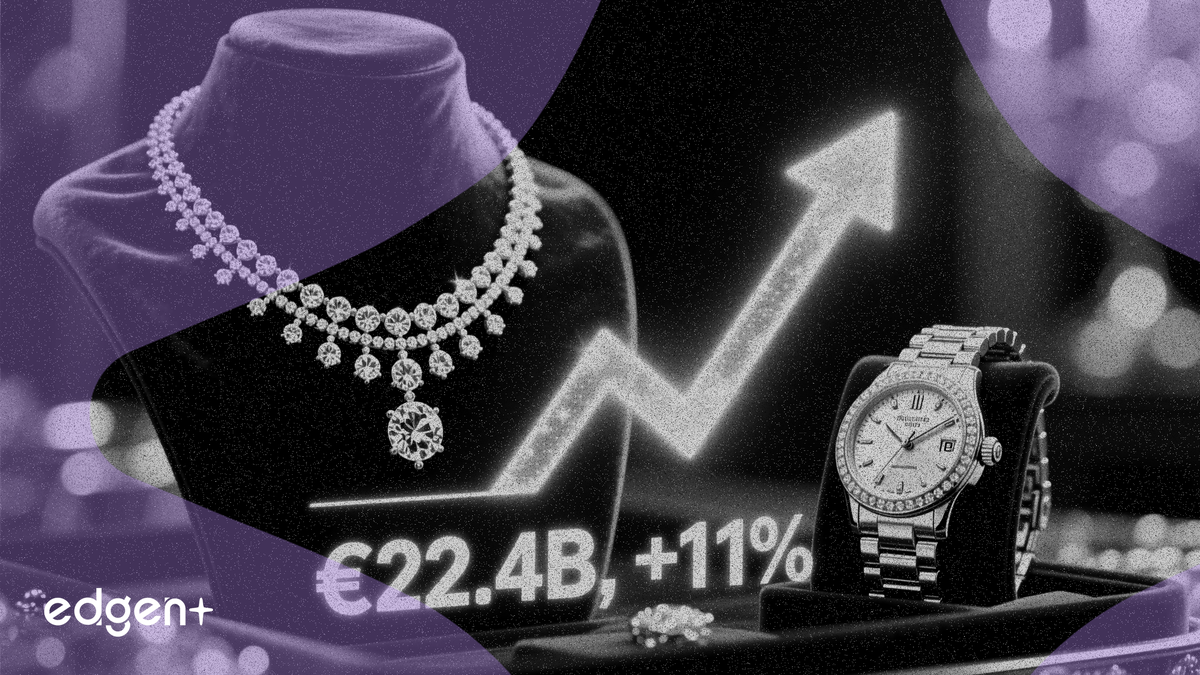
Cartier-owner Richemont reported an 11% increase in full-year sales at constant currencies, reaching €22.4 billion as strong performance at its jewellery brands countered weakness in the watch market and geopolitical headwinds.
"In a persistently volatile geopolitical environment, the Group delivered strong growth and solid results," Chairman Johann Rupert said in a statement. He noted, however, that "uncertainty is likely to persist, not least in relation to developments in the Middle East."
The Swiss luxury group’s sales for the three months ended March 31 rose 13% in constant currencies to €5.40 billion, beating analyst forecasts of €5.30 billion. For the full fiscal year, operating profit held steady at €4.5 billion, while profit for the year jumped 27% to €3.5 billion, reflecting the non-recurrence of a major write-down in the prior year. The group's net cash position grew to €8.5 billion.
The company's Jewellery Maisons division, which includes Buccellati, Cartier, and Van Cleef & Arpels, was the primary growth engine. The unit posted a 14% sales increase at constant rates to €16.5 billion for the year. In contrast, the Specialist Watchmakers division saw sales climb a modest 1% at constant rates to €3.1 billion, though this included a return to growth in the second half of the year.
Regional Strength and Weakness
Growth was geographically broad-based. The Americas delivered double-digit growth throughout the year. Asia Pacific grew by high single digits, with a notable 14% quarterly sales jump, driven by strong demand in Hong Kong and South Korea. Japan also saw a robust 28% increase in the fourth quarter when adjusted for currency swings.
However, the conflict in the Middle East impacted regional sales, which fell by 3% in the fourth quarter, a sharp reversal from the 20% growth seen in the previous quarter. For the full year, the Middle East & Africa region still posted double-digit growth.
Outlook and Shareholder Returns
The results show Richemont's resilience compared to rivals like LVMH and Hermes, whose shares have fallen 27% and 24% respectively year-to-date, while Richemont's have declined a more modest 9%. The company's direct-to-client sales now represent 77% of total group sales.
Based on the strong performance and cash position, the board proposed a 10% increase in the ordinary dividend to CHF 3.30 per share and an additional special dividend of CHF 1.00 per share. The dividend is subject to shareholder approval at the company's annual general meeting on September 9, 2026.
The strong results from the jewellery division suggest continued robust demand for high-end luxury goods, even as the broader sector faces a more challenging environment. Investors will watch for the closing of the sale of the Baume & Mercier watch brand to the Damiani Group, expected in the summer of 2026, as a key upcoming catalyst.
This article is for informational purposes only and does not constitute investment advice.