
The global oil market has absorbed the loss of 13 million barrels per day, but analysts warn the clock is ticking on a full-blown supply crisis.
The global oil market has absorbed the loss of 13 million barrels per day, but analysts warn the clock is ticking on a full-blown supply crisis.
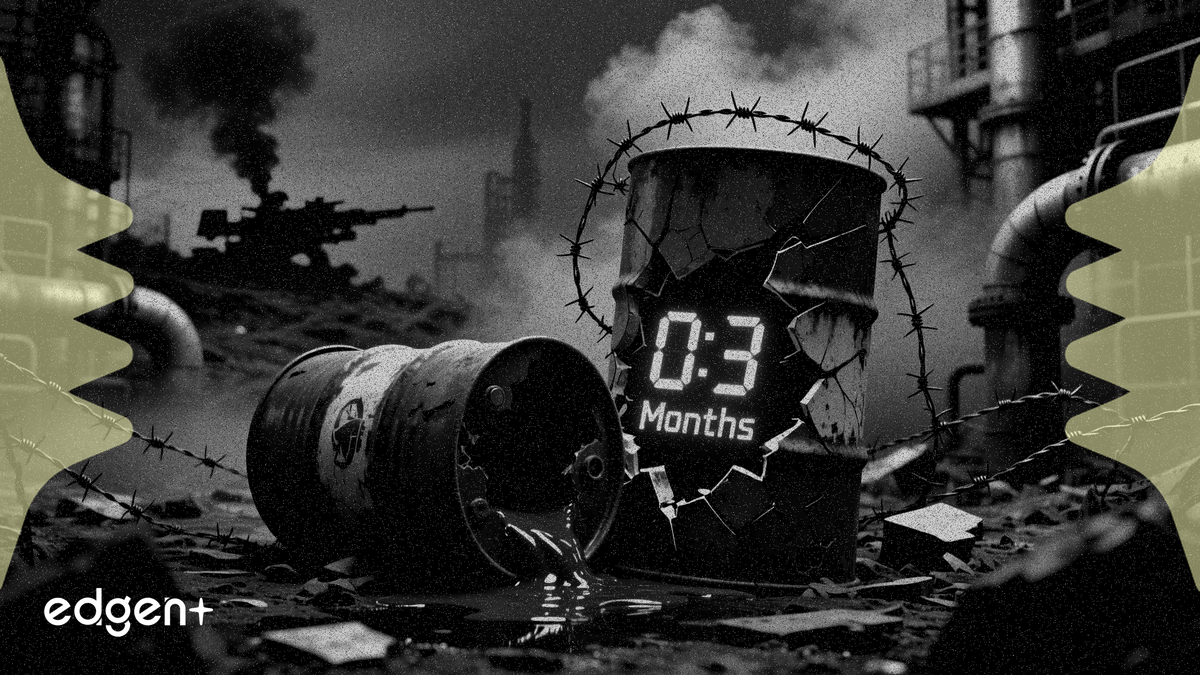
Brent crude has surged roughly 50 percent to $110 a barrel since the start of the Iran war, as the near-total closure of the Strait of Hormuz triggers the fastest depletion of global oil inventories in modern history, putting the market on a three-month countdown to a potential supply breaking point.
"The oil industry has shown remarkable resilience... But barring a breakthrough in peace talks, the global market may be only months away from a breaking point," Reuters columnist Ron Bousso wrote.
The supply shock, equivalent to the loss of 13 million barrels per day, has been met by record releases from strategic reserves and early signs of demand destruction. Still, global crude stocks fell by 8.62 million bpd in April and are forecast to draw by another 9 million bpd in May, according to the International Energy Agency. Some analysts see a much steeper decline, with veteran analyst Paul Horsnell estimating a June drawdown of 11.2 million bpd.
At this pace, commercial inventories could hit minimum operating levels as early as August, a scenario that would force severe economic pain through demand destruction. The crisis has sent ripples across other markets, with gold holding firm as a safe-haven asset, and has translated directly into higher costs for consumers, with diesel prices in Ghazipur, India, for example, rising nearly 5 percent in May to ₹92.66 per litre.
The world has so far avoided a full-blown panic by pulling multiple levers. The International Energy Agency coordinated a record 400 million-barrel release from member states’ strategic reserves, while import-dependent economies in Asia quickly pivoted to secure alternative supplies from the U.S. and Latin America.
However, these measures are finite buffers against an unprecedented disruption. The blockage of the Strait of Hormuz, previously the conduit for a fifth of global energy supplies, has stretched for months, a scenario few experts had anticipated. This has forced refiners to cut production and airlines to trim schedules, with the IEA estimating global oil demand will contract by 2.4 million barrels per day in the second quarter.
While the oil market faces a supply crunch, other assets are reacting to the complex geopolitical fallout. "Gold is supported by growing optimism that a US-Iran peace agreement could ease inflationary pressures and reduce concerns over interest rate hikes," noted Jigar Trivedi, Senior Research Analyst at IndusInd Securities, highlighting the divergent pressures on different commodity classes.
Ultimately, the market's fate hinges on the geopolitical endgame. Projections from the IEA that inventories could begin to rebuild by September rest on the critical, and increasingly optimistic, assumption that the Strait of Hormuz reopens by late May. With each passing day, the strain on the global energy system intensifies, bringing the breaking point steadily closer.
This article is for informational purposes only and does not constitute investment advice.
