


Nvidia's Vera Rubin faces its first credible rack-scale rival as AMD's Helios platform enters production, threatening the chipmaker's dominance in AI infrastructure.
Nvidia's Vera Rubin faces its first credible rack-scale rival as AMD's Helios platform enters production, threatening the chipmaker's dominance in AI infrastructure.
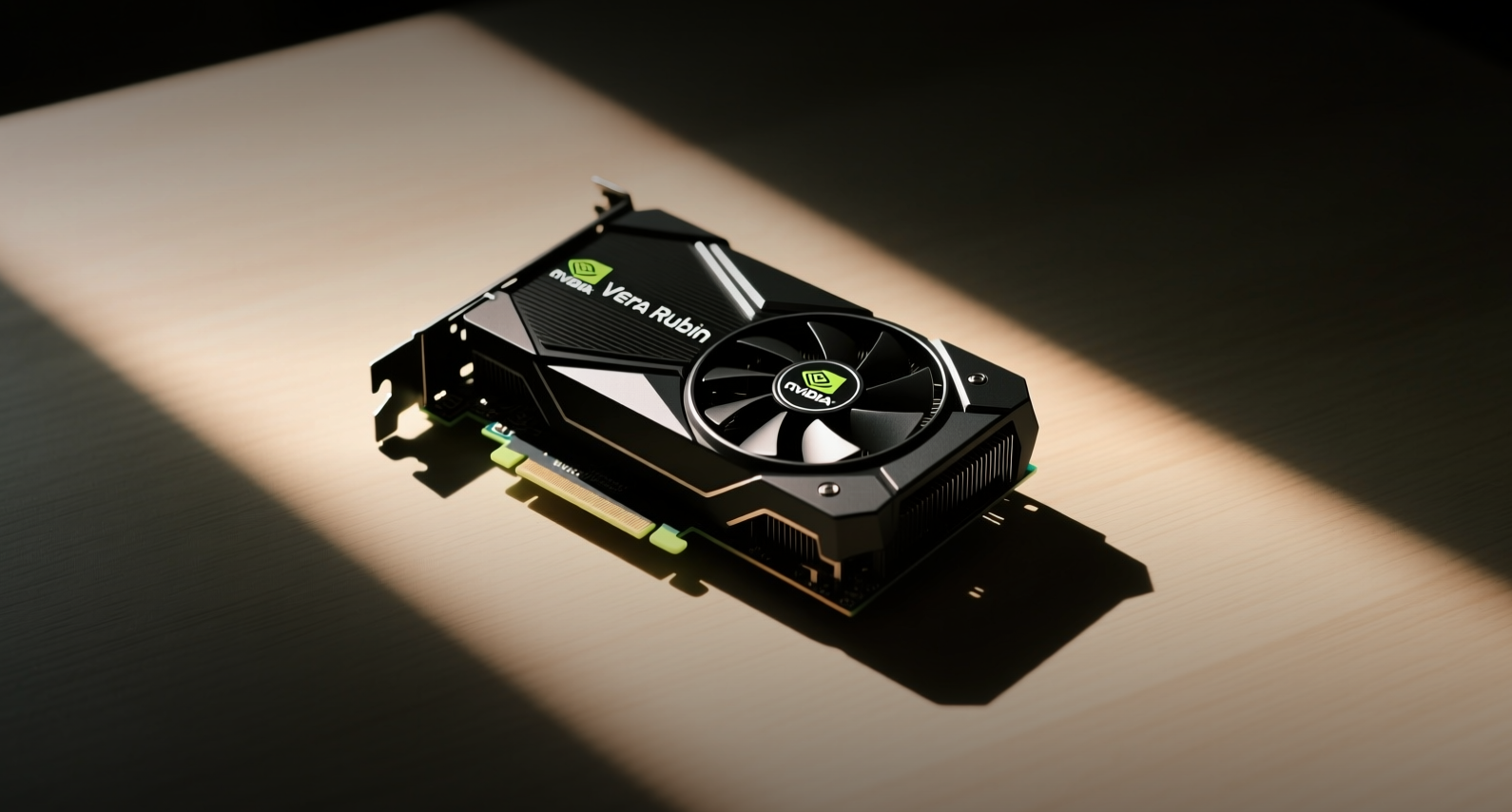
Nvidia shares have gained just 7.3 percent year to date, trailing the PHLX Semiconductor Index's 101 percent surge by nearly 94 percentage points, as the broadening of AI chip spending to rivals including Advanced Micro Devices threatens the company's dominance of the $200 billion-plus market for data center accelerators.
"The hyperscalers' share price decline this month points to increasing shareholder pressure to justify their spending, and we acknowledge that the risk of slowing capex growth has risen at the margin," Mark Haefele, chief investment officer at UBS Global Wealth Management, wrote in a research note.
Nvidia's next-generation Vera Rubin NVL72 — now in production and heading to eight confirmed cloud partners in the second half of 2026 — delivers 3.6 exaFLOPS of FP4 inference and 2.5 exaFLOPS of FP8 training across 72 Rubin R100 GPUs per rack, with 260 terabytes per second of NVLink 6 bandwidth. But AMD's Helios platform, built around the Instinct MI455X on TSMC's 2-nanometer process node (which packs more transistors per square millimeter, improving performance per watt), counters with 432 gigabytes of HBM4 memory per GPU — 50 percent more than Vera Rubin's 288 gigabytes — giving Helios 31 terabytes of total memory per rack versus 20.7 terabytes for the Nvidia system.
The memory advantage is not cosmetic. When running inference on trillion-parameter models — the dominant workload for AMD's largest customer deployments, according to Chief Executive Lisa Su — the amount of memory determines whether the model fits on a single rack or must be partitioned across multiple systems, introducing communication overhead that slows throughput. Nvidia maintains a structural lead in training, where Vera Rubin's 2.5 exaFLOPS at FP8 compares with Helios's 1.4 exaFLOPS, and in interconnect architecture optimized for mixture-of-experts routing, the dominant pattern in frontier AI models.
The Competitive Landscape Widens
AMD's customer commitments provide a floor under the hardware thesis. The company and OpenAI announced a 6-gigawatt infrastructure agreement in October 2025, with the first gigawatt of MI450-series capacity beginning deployment in the second half of 2026. Oracle Cloud Infrastructure committed to deploying 50,000 MI450-series GPUs starting in the third quarter of 2026, building what it describes as the first publicly available AI supercluster on AMD Helios racks. Rackspace Technology signed a definitive agreement on June 16 for a phased deployment of 30 megawatts of AMD compute capacity across its global data centers from late 2026 through 2028.
AMD's Data Center segment revenue reached $5.8 billion in the first quarter of 2026, up 57 percent from a year earlier. Cantor Fitzgerald raised its AMD price target to $700 from $500 on June 29 — the highest on Wall Street — citing the company's leading momentum in compute among semiconductor companies.
The competitive threat extends beyond AMD. Custom chip designers including Broadcom and Marvell Technology, along with Intel's emerging AI accelerator lineup, are competing for hyperscaler procurement budgets that face increasing scrutiny. Big Tech companies may resist relying predominantly on a single supplier even if Nvidia's Vera Rubin establishes a clear performance gap, especially as shareholders question the scale of capital spending.
What Vera Rubin Must Prove
Nvidia revised its Vera Rubin specification at CES in January, increasing HBM4 memory bandwidth 10 percent specifically to stay ahead of the MI455X — a signal that the company takes the AMD threat seriously. The Rubin NVL72 delivers 22 terabytes per second of bandwidth per GPU versus 19.6 terabytes per second for Helios, and Nvidia's NVLink 6 interconnect provides full all-to-all connectivity optimized for the mixture-of-experts routing patterns that dominate frontier AI model architectures.
But AMD's Helios uses an open-ecosystem interconnect — UALink-over-Ethernet running on standard 800 gigabit-per-second Ethernet hardware — meaning data center operators can source networking equipment from competitive suppliers rather than from a single vendor. Nvidia's NVLink switch is available only from Nvidia, a cost line item that Helios avoids.
The key question is whether Vera Rubin's performance gap is wide enough to justify single-supplier dependency. Helios engineering samples and limited-volume production are targeted for the second half of 2026, with full mass production expected by the second quarter of 2027. AMD shares rose 7.7 percent on Tuesday, while Nvidia gained 2.6 percent to close at $200.09 — still 11 percent below the $226 level where Barron's named it a stock pick on May 13.
Nvidia shares trade at roughly 35 times forward earnings, a premium that reflects its dominant position in AI training infrastructure. If Vera Rubin fails to establish a decisive performance advantage, or if hyperscaler spending growth slows, that multiple could face compression. The second half of 2026 will determine whether Nvidia's hardware lead is widening or narrowing — and whether the stock's underperformance relative to the semiconductor index is a buying opportunity or a warning.
This article is for informational purposes only and does not constitute investment advice.
