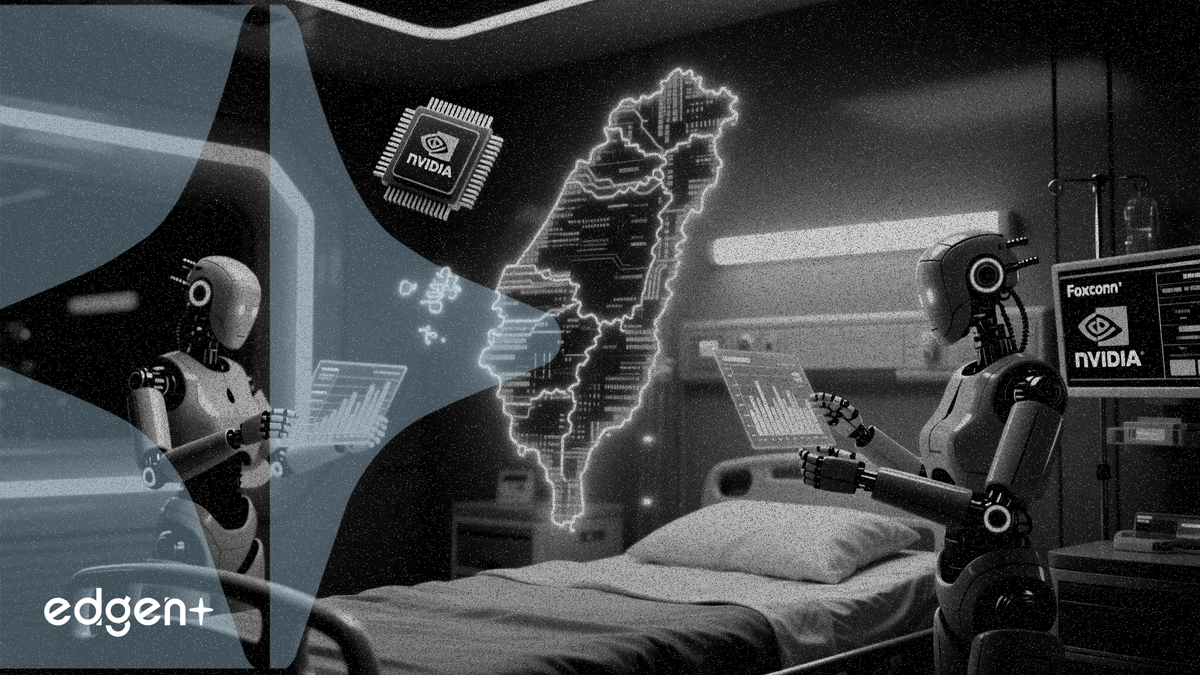
Foxconn is deploying Nvidia-powered AI agent workforces across Taiwan's leading medical centers, moving from individual AI tools to coordinated teams of digital and physical agents that help clinicians reason, document and orchestrate care — a shift that positions the island's $1.5 billion "Healthy Taiwan" initiative as a reference model for health systems worldwide.
"The next era of healthcare is being powered by agentic AI — teams of digital and physical AI agents working alongside clinicians," said Kimberly Powell, vice president of healthcare at Nvidia. "Together with Foxconn and Taiwan's leading medical centers, Nvidia is accelerating the deployment of AI infrastructure that helps clinical teams, improves hospital efficiency and creates a model for health systems around the world."
Foxconn's CoDoctor AI platform now includes specialized digital agents for cardiovascular care, oncology and ophthalmology. New additions include the ECG AI Agent for triaging cardiac patients, the Corovia AI Agent that reconstructs the heart and coronary arteries in 3D — compressing a two-hour workflow to one minute — and the Endovia AI Agent for real-time colonoscopy lesion detection with millisecond-level edge inference. These agents run on Nvidia's full-stack platform, using Nemotron open models for clinical reasoning and NemoClaw, an open-source blueprint for multi-agent orchestration that Foxconn has integrated into its CoDoClaw system.
Physical AI agents are also entering hospital floors. Foxconn's Nurabot nursing collaborative robot, powered by Nvidia's physical AI stack, completed field validation at Taichung Veterans General Hospital and is expanding to Taipei Veterans General Hospital and Tungs' Taichung MetroHarbor Hospital, as well as long-term care facilities. By handling transport and logistics, Nurabot frees an estimated two to three hours per day per nurse for direct patient care. Foxconn's new Scrub Bot, an AI-enhanced scrub nurse robot, operates in live surgical suites, responding to surgeon voice commands. Nvidia's Agent-Ready Rheo blueprint within Isaac for Healthcare helps automate simulation-to-real pipelines, and Foxconn's digital twin approach — building Nvidia Omniverse-powered virtual replicas of hospitals — has cut deployment time by 40% and achieved 98% navigation accuracy.
The Taiwan Healthcare AI Stack
Taiwan's concentration of semiconductor and systems manufacturing — Nvidia now spends $100 billion annually in the country, on a path to $150 billion — extends into healthcare AI infrastructure. TSMC, which controls roughly 72% of global leading-edge foundry output, fabricates the chips powering these agents. Foxconn assembles the servers. The island's medical centers provide the clinical data and validation environment. This vertical integration gives Taiwan an advantage in deploying AI at scale: a majority of its medical centers now operate mature AI systems in daily workflows, handling more than 14 million patient encounters annually across sites including Chang Gung Memorial Hospital, National Taiwan University Hospital and MacKay Memorial Hospital.
The competitive stakes are clear. Nvidia's push into healthcare agentic AI opens a new revenue vertical beyond its core data center GPU business, which generated $75.2 billion in Q1 fiscal 2027 — up 92% year-over-year. The company's Q2 guidance of approximately $91 billion assumes zero data center compute revenue from mainland China after U.S. export restrictions eliminated Hopper-class chip sales there, making new markets like healthcare increasingly important. Taiwan revenue surged more than 50% year-over-year in the most recent quarter, filling part of the gap left by China's collapse.
What This Means for Investors
For Nvidia shareholders, the healthcare AI deployment validates a thesis that has been slow to materialize: that the company's GPU-centric AI platform can expand into enterprise verticals beyond hyperscaler data centers. The 85 FDA- or TFDA-cleared medical AI solutions already operating in Taiwan demonstrate regulatory traction. Foxconn, as ecosystem integrator, connects government programs, hospitals, device makers and software companies — a role that positions it to capture recurring service revenue from the $1.5 billion Healthy Taiwan initiative.
The risk is concentration. Taiwan imports 97% of its energy, and any supply disruption would affect not just chip production but the healthcare AI systems running on that infrastructure. Nvidia's 50-year lease for its Constellation headquarters campus in Taipei — a $1.27 billion investment housing 4,000 employees — signals the company views this as a permanent strategic anchor. But the same geography that makes Taiwan indispensable for AI chip manufacturing now makes it indispensable for AI-powered healthcare delivery, compounding the island's structural importance in the global technology stack.
This article is for informational purposes only and does not constitute investment advice.