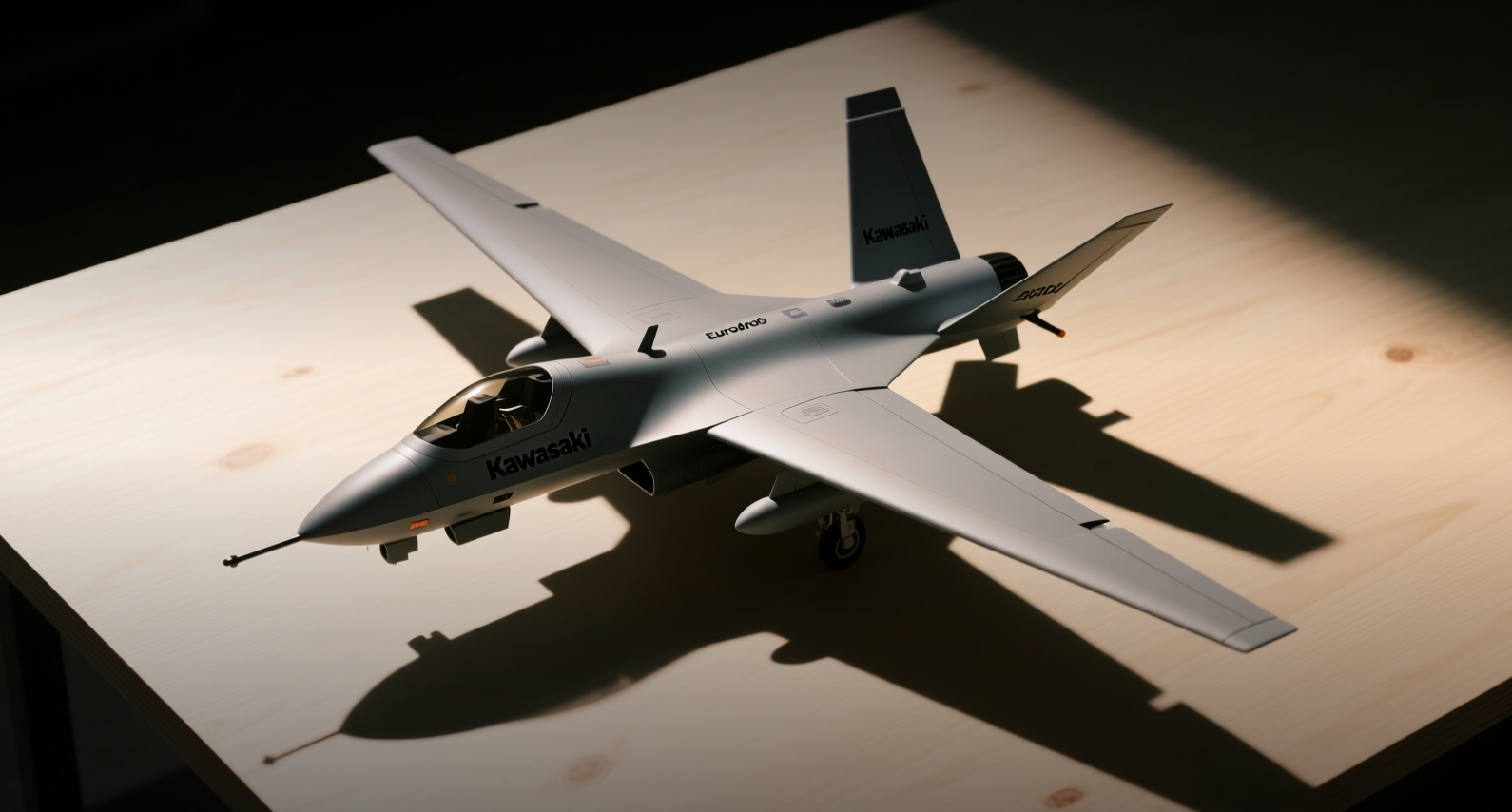
Japan's Kawasaki Heavy Industries will form a technical tie-up with Airbus Defence and Space for defense drones, the Nikkei business daily reported Friday, as Tokyo accelerates the most consequential shift in its security posture since 1954 with a ¥43 trillion defense buildup.
"The collaboration brings together Kawasaki's anti-submarine warfare expertise with Airbus's unmanned aerial systems platform," a person familiar with the matter told Nikkei. Kawasaki is expected to provide anti-submarine warfare systems for the Eurodrone project, a four-nation development program involving Germany, France, Italy and Spain, with plans to jointly propose the product to Japan's defense ministry.
The deal marks the first time a Japanese heavy industry firm has partnered with a foreign major on defense drones, reflecting a broader pivot in Tokyo's defense strategy. Japan is increasing defense spending from the postwar ceiling of roughly 1% of gross domestic product to about 2%, closer to the NATO average, under a five-year plan approved in 2022 that commits approximately ¥43 trillion. The country is also acquiring U.S. Tomahawk missiles, extending the range of its indigenous Type-12 missile, and developing longer-range strike systems capable of hitting military targets far from its shores.
The partnership addresses a critical gap in Japan's defense capabilities. The country lags considerably behind China when it comes to drones, and recent budgets place major emphasis on reconnaissance drones, unmanned maritime systems, drone-defense technologies and autonomous systems for operations around the East China Sea and Taiwan region. The last time Japan pursued a major foreign defense technology partnership was its selection of the F-35 fighter jet in 2011, a program that has since grown to more than 100 aircraft on order.
For Airbus, the deal provides a strategic foothold in Japan's expanding defense market at a time when European defense contractors are seeking new customers amid rising global military spending. The Eurodrone program, Europe's largest unmanned aerial system initiative, is designed to fill a medium-altitude long-endurance capability gap that has become more pressing since Russia's invasion of Ukraine reshaped European defense priorities.
Prime Minister Sanae Takaichi, who took office in October 2025, has continued the defense policy trajectory set by her predecessors beginning with Shinzo Abe roughly a decade ago. The buildup also includes reinforcing the southwest islands stretching toward Taiwan with missiles, radar systems and amphibious forces, and joining the Global Combat Air Programme with the U.K. and Italy to develop a next-generation fighter aircraft.
The implications extend beyond Japan's borders. A more capable Japanese defense industrial base, integrated with European partners, could reshape the balance of unmanned systems in the Indo-Pacific. Japan's demonstrated willingness to spend 2% of GDP on defense — a level that satisfies NATO benchmarks — also strengthens its position with the U.S., which remains the ultimate guarantor of Japanese security. The Kawasaki-Airbus partnership gives both sides a concrete vehicle to pursue that goal.
This article is for informational purposes only and does not constitute investment advice.