

Key Takeaways:
- Ford sold just 3,513 EVs in May, down 44% year over year
- The F-150 Lightning and Mustang Mach-E both cratered to near-zero levels
- Ford expects $19.5 billion in EV-related charges as it pivots to a 2027 midsize truck
Key Takeaways:
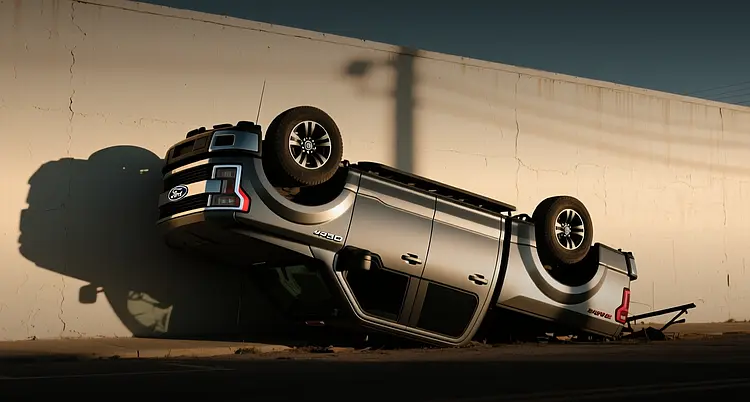
Ford Motor Co. sold just 3,513 electric vehicles in May — a 44% year-over-year decline — as its Mustang Mach-E and F-150 Lightning both cratered to near-zero levels.
Ford Motor Co.'s two flagship electric vehicles sold a combined 3,513 units in May, down 44% from a year earlier, as the automaker's multibillion-dollar EV bet unraveled. The Mustang Mach-E delivered 2,467 vehicles and the F-150 Lightning just 1,046 — or 82 and 45 per day nationwide, respectively.
"There's no real competition from Tesla, GM, or Ford with what we've seen from China," Chief Executive Officer Jim Farley said after test-driving Chinese EVs, calling them an existential threat to the automaker. "They are completely dominating the EV landscape globally."
Ford's total second-quarter U.S. sales fell 10% year over year to 549,200 vehicles, dragged by discontinued models and a 69% decline in daily rental sales. First-half deliveries totaled 1 million units, down 9.6% from 1.1 million in the same period of 2025. The company now expects about $19.5 billion in EV-related special items, mostly in 2025 but extending through 2027, citing lower-than-expected demand, higher costs and unfavorable regulatory changes.
Ford ended production of the current-generation F-150 Lightning at the close of 2025 and is now pivoting to a $5 billion Universal EV Platform, with the first product — a midsize electric pickup — scheduled for 2027. The shift comes as the original $39,974 Lightning Pro, marketed as an affordable entry point, rose 37% to $54,780 by 2026 and was eventually restricted to fleet buyers only.
The $40,000 Promise That Never Materialized
The original 2022 Lightning Pro, priced at $39,974 before destination, offered 452 horsepower and 775 pound-feet of torque with a standard-range battery. By 2026, the same trim had climbed to $54,780 — a 37% increase — and was no longer available to retail customers. The cheapest retail model now starts near $63,000 before destination, pushing the electric pickup firmly into luxury territory.
Ford wasn't alone in this pricing gravity. Chevrolet's Silverado EV starts at $55,895 for the Custom trim, but the company's main vehicle page leads with an "as shown" vehicle at $86,600. Across the industry, the estimated average transaction price for a new EV exceeds $58,000, according to Cox Auto and Kelley Blue Book data, with full-size pickups running significantly higher.
Bright Spots Remain in Combustion and Hybrid
Ford's bright spots remain in its combustion and hybrid lineup. The Maverick, America's best-selling hybrid pickup, posted a record second quarter with sales rising 19.3% to 29,457 units. Bronco sales hit a record 76,936 vehicles in the first half, outselling the Jeep Wrangler during the quarter. Explorer sales climbed 21% to 126,925 units, supported by a refreshed trim lineup.
Ford Pro's paid software subscriptions exceeded 900,000 in the first half, up about 20%, while cumulative hands-free driving hours using BlueCruise surpassed 12 million. These service-based revenue streams offer higher margins than vehicle sales but remain a fraction of the scale needed to offset the EV division's losses.
What's Next for Ford's EV Strategy
Ford's $5 billion Universal EV Platform, which management has called the largest production revolution since the Henry Ford assembly line, targets a 2027 launch for a midsize electric pickup. The platform is designed to produce affordable vehicles, but given the pace at which the EV segment is evolving, 2027 may arrive late. Several European automakers have accelerated their EV programs, and GM continues to invest across multiple price points.
For investors, the question is whether Ford can execute its pivot before competitors capture the mid-size EV truck market. Ford shares face headwinds from the $19.5 billion in expected EV-related charges, and the company's retreat from full-size battery electric trucks raises doubts about its ability to compete in a segment where Chinese rivals are driving costs below $20,000 per vehicle.
This article is for informational purposes only and does not constitute investment advice.
