
BYD is building the world's fastest EV charging network at a pace that threatens to make range anxiety a relic of the past.
BYD is building the world's fastest EV charging network at a pace that threatens to make range anxiety a relic of the past.
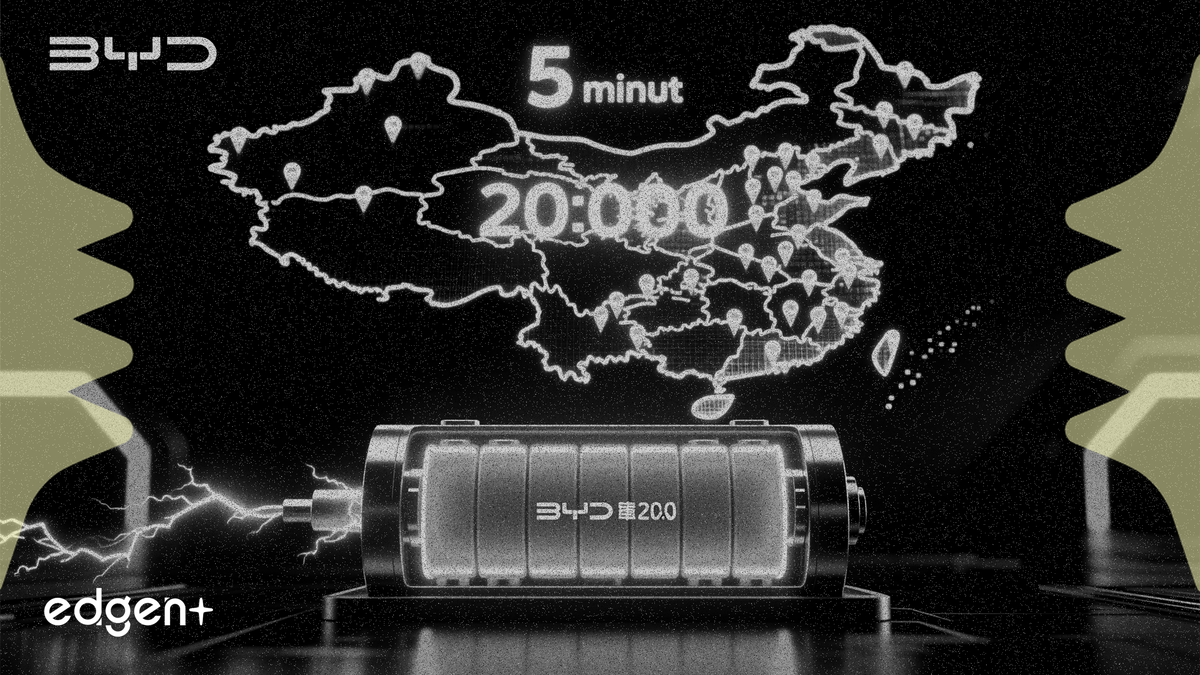
BYD is building the world's fastest EV charging network at a pace that threatens to make range anxiety a relic of the past.
BYD plans to build 20,000 flash charging stations by the end of 2026, deploying its second-generation Blade Battery that charges from 10 percent to 80 percent in five minutes — roughly three times faster than Tesla's Supercharger V4 at peak output.
"The flash charging technology works anywhere, even at minus 30 degrees Celsius, where it adds only three minutes to the charge time," Stella Li, executive vice president at BYD, said. The company demonstrated the system in Shenzhen, where a frozen vehicle reached 97 percent charge in 12 minutes compared with nine minutes at 30 degrees Celsius.
As of May, BYD has built 6,150 flash charging stations across China, including 149 in Shenzhen. Each station delivers up to 1,500kW per connector using a power reservoir and amplifier that BYD says makes it 10 times more efficient than conventional chargers. The second-generation Blade Battery, now produced at BYD's Shenshan Phase I facility, uses lithium iron phosphate (LFP) chemistry — cheaper and safer than nickel-manganese-cobalt (NMC) cells — and achieves a CLTC range of over 1,000 kilometers (621 miles).
The aggressive infrastructure buildout addresses the single biggest barrier to EV adoption — charging speed and availability — and positions BYD to extend its lead over Tesla, NIO, and XPeng in China's price-competitive EV market. BYD sold 383,453 new energy vehicles in May, up 20 percent from April, with overseas sales surpassing 160,000 units for the first time and accounting for 41 percent of total sales.
How Flash Charging Works
BYD's system pairs a T-shaped gantry with charging guns suspended from a sliding rail, making the cables light enough for easy handling. Payment in China uses a digital handshake via smartphone app. The company plans to bring the technology to the UK and Europe this year, starting with the Denza Z9 GT, a high-performance model that can crab-walk and is the first overseas vehicle equipped with the new battery and charging system.
The flash charger's ability to operate at extreme temperatures was demonstrated in a booth cooled to minus 30 degrees Celsius. A technician in a thick winter coat plugged in a charging gun and exited; the vehicle reached 97 percent charge in 12 minutes — only three minutes slower than at 30 degrees Celsius.
Competitive Pressure and the Road Ahead
BYD's charging network expansion comes as Chinese EV makers race to eliminate charging time as a purchase deterrent. Tesla's Supercharger V4 delivers up to 500kW, while NIO's battery-swap stations take about five minutes but require swapping infrastructure. BYD's 1,500kW flash charging, if deployed at scale, could make both approaches look slow.
The company is already struggling to meet demand for vehicles equipped with the new technology. BYD's CEO Wang Chuanfu said orders for some models have exceeded 100,000, outstripping production capacity. The second-generation Blade Battery is produced at the Shenshan Phase I facility, with Phases II through IV ramping up.
Looking further ahead, BYD aims to begin limited production of all-solid-state batteries in 2027, using sulfide electrolytes that the company says offer longer life and greater stability than liquid lithium-ion cells. Chief scientist Lian Yubo said solid-state batteries will complement rather than replace liquid batteries, urging continued investment across all battery chemistries.
BYD shares trade on the Shenzhen Stock Exchange. The company's market capitalization stands at roughly $140 billion, making it the world's largest EV maker by sales volume. Tesla, its closest global rival, trades at a market cap of about $1 trillion but trails BYD in unit sales and charging speed.
This article is for informational purposes only and does not constitute investment advice.
