

Broadcom's new inference chip with OpenAI targets the fastest-growing segment of the AI semiconductor market — and arrives as the company's custom silicon business is already doubling annually.
Broadcom's new inference chip with OpenAI targets the fastest-growing segment of the AI semiconductor market — and arrives as the company's custom silicon business is already doubling annually.
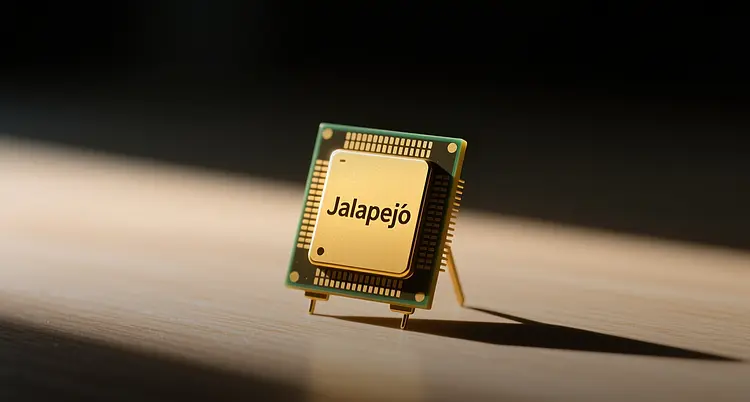
Broadcom's partnership with OpenAI on a custom inference chip codenamed Jalapeño targets the fastest-growing segment of the AI chip market, as the company's custom silicon business is on track to double this year to $16 billion in quarterly revenue.
"The inference market is where the volume is, and custom chips optimized for specific models deliver the lowest total cost of ownership," said Harlan Sur, semiconductor analyst at JPMorgan, which has a $580 price target on Broadcom.
The Jalapeño chip is designed specifically for large language model inference — the process of running trained AI models to generate responses. Broadcom did not disclose performance benchmarks or the manufacturing process node, but the chip enters a market dominated by Nvidia's H100 and Blackwell GPUs, which deliver up to 990 TFLOPS of FP16 compute on TSMC's 4nm node. Broadcom's custom ASIC (application-specific integrated circuit) approach typically offers lower power consumption and cost per inference than general-purpose GPUs, making it attractive for hyperscale deployments.
Broadcom shares, which fell nearly 20 percent in two days after the company's fiscal second-quarter earnings report, trade at roughly 61 times forward earnings — a premium reflecting the market's bet on its custom silicon strategy. The stock closed at $376.21, well below the $523.73 analyst consensus target, with 44 buy ratings and zero sell ratings.
Broadcom's existing AI chip business is built around custom XPUs for hyperscalers including Google, Meta, Anthropic and OpenAI itself. The company's fiscal Q2 AI semiconductor revenue reached $10.8 billion, up 143 percent from a year earlier, and management guided for Q3 AI chip revenue to grow more than 200 percent year over year to $16 billion. The Jalapeño chip represents Broadcom's first publicly disclosed chip designed specifically for a single AI model provider's inference workload, rather than a general-purpose custom accelerator.
The OpenAI partnership also addresses a key investor concern. After Broadcom's last earnings call, Chief Executive Officer Hock Tan said the company "fully expects that there will be some diversity of sources" for its largest customer, Alphabet's Google, which has worked with Broadcom on multiple generations of tensor processing units (TPUs). JPMorgan's Sur pushed back on fears that Broadcom is losing its position at Google, arguing that a five-year agreement signed in March "locks in Broadcom's TPU design win roadmap for the next four generations of TPU chips through v11."
The inference chip market represents the next battleground in AI semiconductors. While training chips — dominated by Nvidia with an estimated 80 percent-plus market share — have captured most of the industry's revenue to date, inference workloads are expected to account for the majority of AI compute demand as deployed models scale. Custom ASICs designed for specific model architectures can deliver 2x to 4x better performance per watt than general-purpose GPUs, according to industry estimates.
Nvidia remains the dominant force, with its H100 and upcoming Blackwell architecture commanding premium pricing. But Broadcom's strategy of partnering directly with AI model providers to build custom silicon mirrors the approach that has made it the second-largest semiconductor company by market capitalization. The company's Ethernet networking portfolio, which connects AI server clusters, adds another layer to its AI infrastructure offering.
For investors, the Jalapeño announcement provides a concrete data point in the debate over whether Broadcom can sustain its AI growth trajectory beyond the current hyperscaler buildout cycle. The company's free cash flow reached $10.3 billion in fiscal Q2, representing roughly 46 percent of revenue, and it has beaten earnings per share estimates for eight consecutive quarters. The risk remains customer concentration — a handful of hyperscalers drive the AI revenue line, and any single-customer order delay can compress the multiple quickly.
This article is for informational purposes only and does not constitute investment advice.
