
Iran warned the US that any violation of the ceasefire in Lebanon would be treated as a breach of the entire agreement, linking the fate of two conflicts as Brent crude held above $93 a barrel.
Iran warned the US that any violation of the ceasefire in Lebanon would be treated as a breach of the entire agreement, linking the fate of two conflicts as Brent crude held above $93 a barrel.
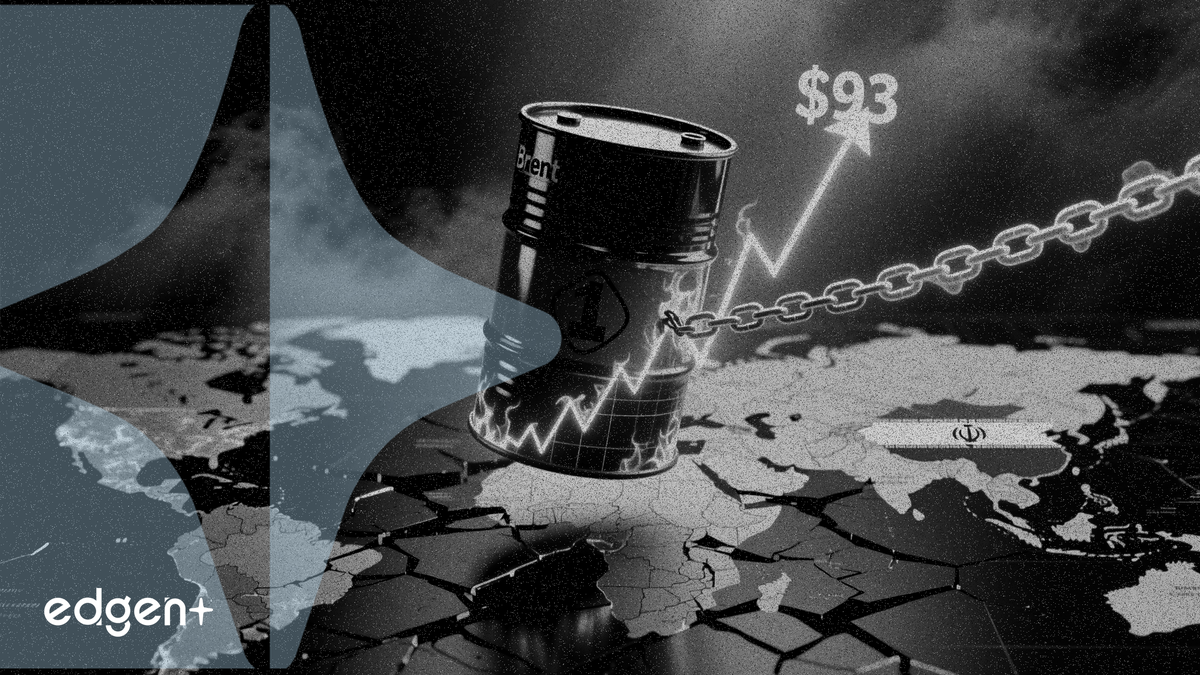
Iran warned the US that any violation of the ceasefire in Lebanon would be treated as a breach of the entire agreement, linking the fate of two conflicts as Brent crude held above $93 a barrel.
Iran's foreign minister said the US-Iran ceasefire explicitly covers all fronts including Lebanon, with any violation on any front treated as a breach of the entire accord, holding the US and Israel responsible for consequences.
"Any front violating the ceasefire means all fronts have violated it, and the US and Israel will bear the consequences," Abbas Araghchi, Iran's foreign minister, said in remarks carried by state media.
The statement came as Brent crude traded at $93.17 a barrel Monday, after closing at its lowest since mid-April on Friday, as traders weighed the prospect of a diplomatic resolution against continued military escalation. Gold slipped 0.4 percent to $4,518 an ounce, while the dollar index edged higher. The Strait of Hormuz, through which about 21 percent of the world's seaborne oil passes, remains effectively closed under the US naval blockade imposed as part of Trump's maximum-pressure campaign.
The linkage between the two conflicts raises the stakes for US negotiators, who have been trading draft proposals with Tehran over the past week. If the Lebanon front collapses the broader ceasefire, oil supply fears could push Brent above $100 — a scenario that would worsen inflation and complicate the Federal Reserve's rate path ahead of the November midterm elections.
Iran's insistence on a unified ceasefire framework reflects deep mistrust after weeks of back-and-forth. The semi-official Tasnim news agency reported Sunday that both sides continued to propose amendments to a draft agreement, with no guarantee of a final deal. Iranian state TV said one version of the draft gives Tehran "exclusive authority to determine the nature of transiting vessels" in the strait — a condition the US is unlikely to accept — and commits Washington to releasing $12 billion in frozen funds within 60 days.
The diplomatic maneuvering unfolded alongside Israel's broadest ground incursion into Lebanon in a quarter-century. Israeli forces seized the medieval Beaufort Castle near Nabatieh over the weekend, with Defense Minister Israel Katz describing the expansion as "a permanent presence" in the region. Hezbollah responded by firing more than 300 projectiles at Israeli positions and northern Israeli towns over the weekend, according to the Israeli military, and shot down an Israeli Hermes 450 drone using a surface-to-air missile.
Escalation Risks and Market Pricing
The last time the Strait of Hormuz faced a sustained disruption was in September 2019, when drone attacks on Saudi Aramco's Abqaiq and Khurais facilities knocked out 5.7 million barrels a day of production — the largest single supply disruption in history. Brent spiked 15 percent in a single session before Saudi Arabia restored output within weeks. The current blockade is broader, targeting all Iranian-linked maritime traffic, and has no clear off-ramp.
Options markets reflect the uncertainty. Brent implied volatility has remained elevated, with the skew toward out-of-the-money calls signaling that traders are pricing a tail risk of prices above $100. Defense stocks have also gained, with the S&P 500 aerospace and defense sub-index rising 3.2 percent over the past week.
French President Emmanuel Macron said Monday he spoke with Trump about the situation, praising US efforts to reach a swift agreement and offering France's support for securing maritime traffic in the strait once a deal is concluded. "This is the purpose of the international mission that we have built with the British and our partners, ready to be deployed as soon as an agreement is concluded," Macron said in a post on X.
Iran's chief negotiator, Mohammad Bagher Ghalibaf, accused the US of breaching the ceasefire by maintaining the naval blockade and failing to restrain Israeli operations in Lebanon. "The naval blockade and escalation of war crimes in Lebanon by the genocidal Zionist regime are clear evidence of US noncompliance with the ceasefire," Ghalibaf wrote on X.
Trump, in a post on Truth Social, said Iran "really wants to make a deal" and that any agreement "states, very clearly, that Iran will not have a Nuclear Weapon." But he also complained that political criticism was making negotiations harder, suggesting a deal is not imminent.
This article is for informational purposes only and does not constitute investment advice.
