

Key Takeaways: AMD's Ryzen AI Halo mini PC runs 120-billion-parameter models locally for $1,500, undercutting Nvidia's DGX Spark by $3,000.
Key Takeaways: AMD's Ryzen AI Halo mini PC runs 120-billion-parameter models locally for $1,500, undercutting Nvidia's DGX Spark by $3,000.
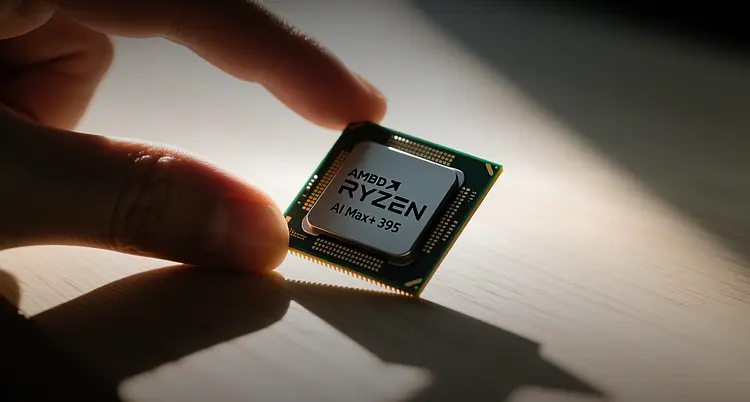
AMD's Ryzen AI Halo workstation processes 34 tokens per second on 120-billion-parameter models at a $1,500 starting price, challenging Nvidia's dominance in local AI inference hardware.
"Local inference is where the next wave of AI deployment happens, and memory capacity is the gating factor," an AMD spokesperson said during the product's launch. "The unified memory architecture lets developers run models that would otherwise require expensive cloud GPU rentals."
The system packs a 16-core Ryzen AI Max+ 395 processor with 128GB of unified LPDDR5X memory, supporting models with up to 120 billion parameters without cloud connectivity. At 34 tokens per second on a 120B-parameter model, it trails Nvidia's DGX Spark by 13% in throughput but costs $3,000 less — the DGX Spark starts at roughly $4,500. AMD's chip uses conventional x64 architecture rather than Nvidia's Arm-based Grace CPU, and its memory cost of $25.77 per gigabyte undercuts Apple's M3 Ultra at $41.66 per gigabyte.
The Strix Halo positions AMD to capture a slice of the local AI inference market, which could reduce enterprise dependence on cloud GPU services from Nvidia and Amazon Web Services. AMD shares have gained 18% year to date, trading at 28 times forward earnings, as the company expands beyond its traditional CPU and GPU businesses into dedicated AI workstations.
How the Hardware Stacks Up
The Ryzen AI Halo, codenamed Strix Halo, is not designed for gaming but for running large language models locally — a workflow that typically requires cloud-based GPU clusters. AMD's unified memory architecture eliminates the VRAM bottleneck that limits Nvidia GPUs, which are constrained by discrete memory pools. For agent-heavy AI pipelines, where multiple models run in sequence, the system's ability to keep 128GB of parameters in memory without paging to slower storage offers a practical advantage over conventional GPU setups.
Memory bandwidth remains a limiting factor. While AMD advertises 256 GB/s of theoretical bandwidth, real-world throughput measures 122 GB/s, compared with Apple's M3 Ultra at 819 GB/s. This gap matters for long-context tasks such as document analysis, where Nvidia's DGX Spark delivers five times faster prefill speeds. AMD did not disclose the test conditions for its token-per-second claims.
Software Remains the Weak Link
AMD's ROCm stack, which supports AI workloads on its hardware, remains in preview and lacks Windows compatibility. Nvidia's CUDA environment, by contrast, is deeply embedded in the AI development workflow, with most open-source models and frameworks optimized for it first. AMD is relying on Vulkan as a temporary workaround, but the software gap limits the Strix Halo's addressable market to Linux-based developers willing to navigate a less mature toolchain.
The Ryzen AI Max+ 395 chip is manufactured on TSMC's 4nm and 5nm nodes, the same foundry that produces Nvidia's H100 and AMD's own Instinct MI300 series. The mini PC is assembled by AMD's OEM partners, with availability initially through Micro Center in the US. AMD has not disclosed production volumes or whether the chip faces any single-source packaging constraints.
What Comes Next
AMD plans to release the next-generation Gorgon Halo chip in the third quarter of 2026, featuring 192GB of unified memory and support for models with up to 300 billion parameters. That would put local inference within reach of frontier models currently requiring multi-GPU server configurations. Nvidia and Qualcomm are also expected to launch competing products in the same timeframe, intensifying the race for the local AI hardware market.
AMD's push into local AI workstations opens a new revenue stream beyond its core CPU and GPU businesses, but the near-term financial impact is likely modest. The $1,500 starting price targets AI developers and researchers — a niche but fast-growing segment. If AMD can close the software gap and deliver on Gorgon Halo's 192GB promise, it could capture meaningful share of the enterprise AI inference market, which IDC projects will reach $52 billion by 2028. For now, Nvidia's CUDA moat and memory bandwidth advantage keep the incumbent firmly in the lead.
This article is for informational purposes only and does not constitute investment advice.
